






Fijian Hairstyle Traditions: Crowning a Legacy of Identity Through Generations
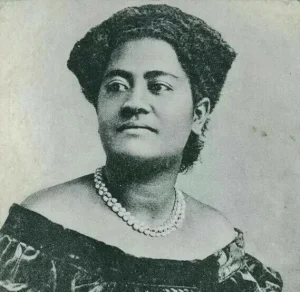
You may have noticed how the Islands of Fiji are represented throughout the Polynesian Cultural Center with an icon of a person rocking an Afro hairstyle. “Afro” is how the world knows it, but in my island home, this hairstyle is a symbol of our identity that has been passed down through generations. We call the hairdo buiniga.
History of Fiji
There are no written records of the people of Fiji until the first voyagers arrived in Fiji. The first ever documentation of the Islands of Fiji is sighted in the journal of Abel Tasman, who is also the first known voyager to have discovered Fiji. W and Henderson’s book, Discovery of the Native Islands highlights Abel Tasman’s records of how he describes his discovery of Fiji and a collection of journals of other voyagers including James Cook, William Bligh, James Wilson, and Fabian Gottlieb von Bellingshausen. It was in Bellingshausen’s journal that the first attention was paid to the details of how Fijians wear their hair. Bellingshausen discovered the islands of Ono-i-lau in 1820. Here is an account of how he describes Fijians.
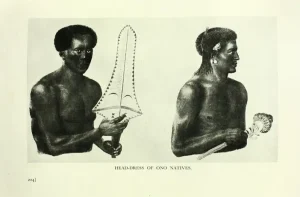
W, J. A., and G. C. Henderson. “Head-dress of Ono Natives”, Feb. 1934, p. 224. https://doi.org/10.2307/1786470.
“His hair has some gray hairs and is carefully dressed like a wig.”
They dress their heads very carefully in the following way: all the hair is divided into tuffs which are bound at the root with a thin thread; then they comb the ends of these tuffs with care, and then their heads are like wigs. Some islanders apply a yellow pigment to their hair; with others, the front hair was only combed, with the back hair and side curl hung twisted into small curls. Many of them had waxed combs made of strong wood and tortoise-shell hairpins a foot long, which were fixed into the hair from one side horizontally. The hairpin is used by islanders when they dress their heads so as not to rumple the beautiful dressing of their hair. For the same reason, the Fijians slept with the neck (not the head) resting on a wooden pillow”(p. 224).
Ulumate or Wig
There was a time in history when wigs were a symbol of status and fashion in English society, reflecting class and prestige. Similarly, Fijians had their obsession for wigs, mostly among the chiefly families. A book titled The Cannibal Islands or Fiji and Its People highlights sentiments of missionaries about Fijians and their hair.
“We wonder at the ladies of former times, who on grand gala-days submitted with patience to the tedious operation of having their hair dressed in imitation of baskets of fruit and flowers. We laugh[ed?] at the Scottish ladies who, when King George IV. visited Holyrood, were so anxious to have their heads fashionably dressed, that they yielded them to the hands of the busy barber days before the court reception. But here we find the savage Fijian undergoing the same trouble and inconvenience, not for a week or a few days, but throughout his whole life. Every chief keeps a full complement of barbers. These are persons of importance and dignity; their hands being sacredly devoted to their master’s head……. The barbers are very expert in making wigs, which defy detection, when a chief is obliged thus to supply his deficiency of hair” (p. 25).
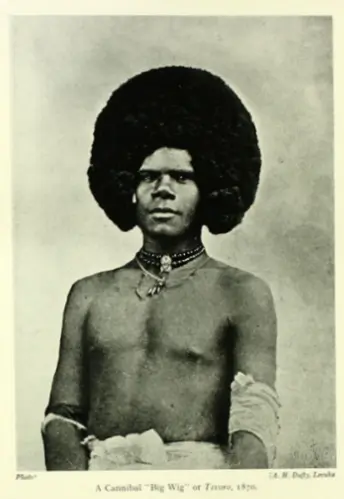
Brewster, Adolph Brewster. “A Cannibal “Big Wig” or Tevoro, 1870”, pg.56, ci.nii.ac.jp/ncid/BA11922531.
There were three distinctions for Fijian wigs:
- Ulumate – hair that is cut and turned to a wig.
- Ulu Cavu – a warrior’s wig, where the warrior would strip the hair of his enemy and turn it into a wig, to wear for the next battle.
- Ulu Vati – the wig from the hair of someone who has passed away (GoFij).
From the journals, it is evident that hairstyles have been an important part of Fijian distinction from the beginning. Fijian hairstyle was and is a symbol of their identity.
Sacredness of the Hair
In the Fijian culture, the head is the most sacred part of the body. One of the most disrespectful acts is touching someone else’s head/hair without permission. History relates the 1867 arrival of a missionary who did not understand the culture. Because he touched the chief’s head without consent, he and seven of his followers were killed.
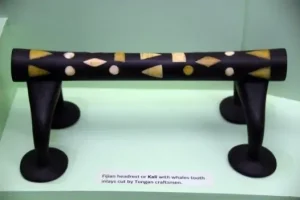
Kali, or the Wooden Pillow
In the past, Fijian pillows were not what you might expect. Our traditional headrest, called the kali, is described as “a rod of wood about an inch in diameter and a foot and a half long, raised about half a foot by two diverging pieces at each end, with the nape of the neck resting upon this” (Cartmail and Keith).