








“Huki” Costumes Take Over a Year to Design and Produce
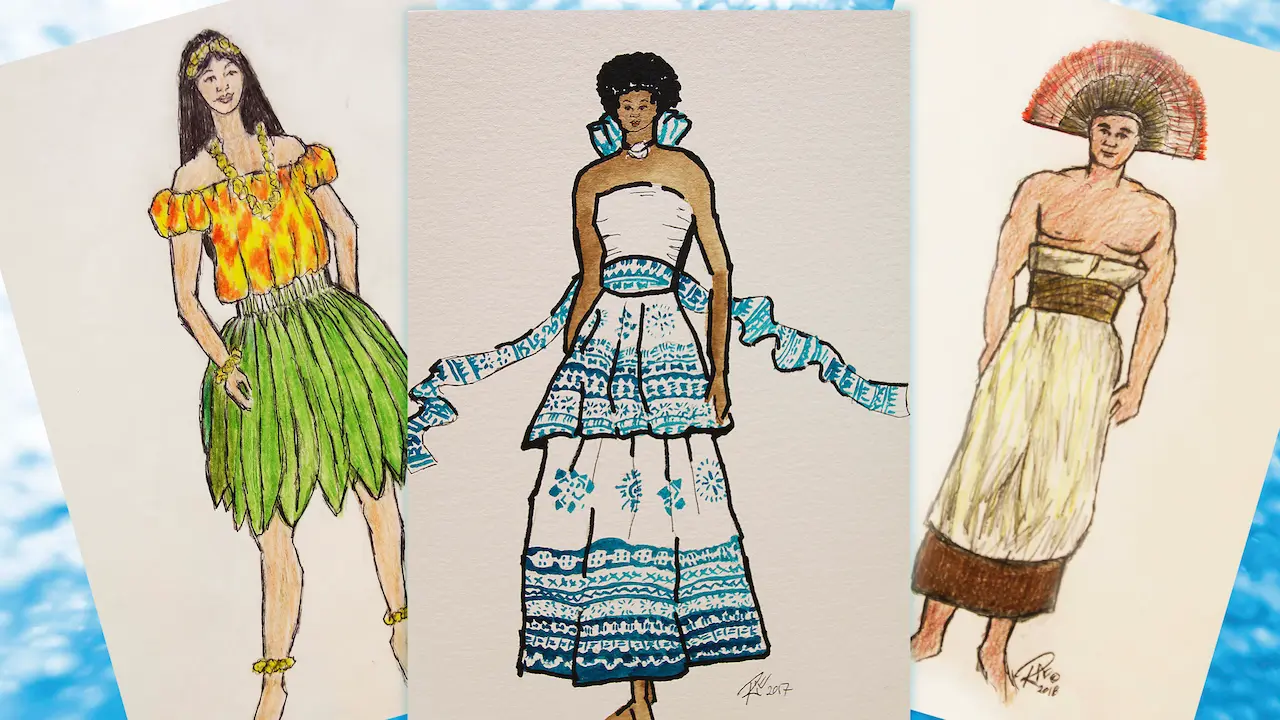
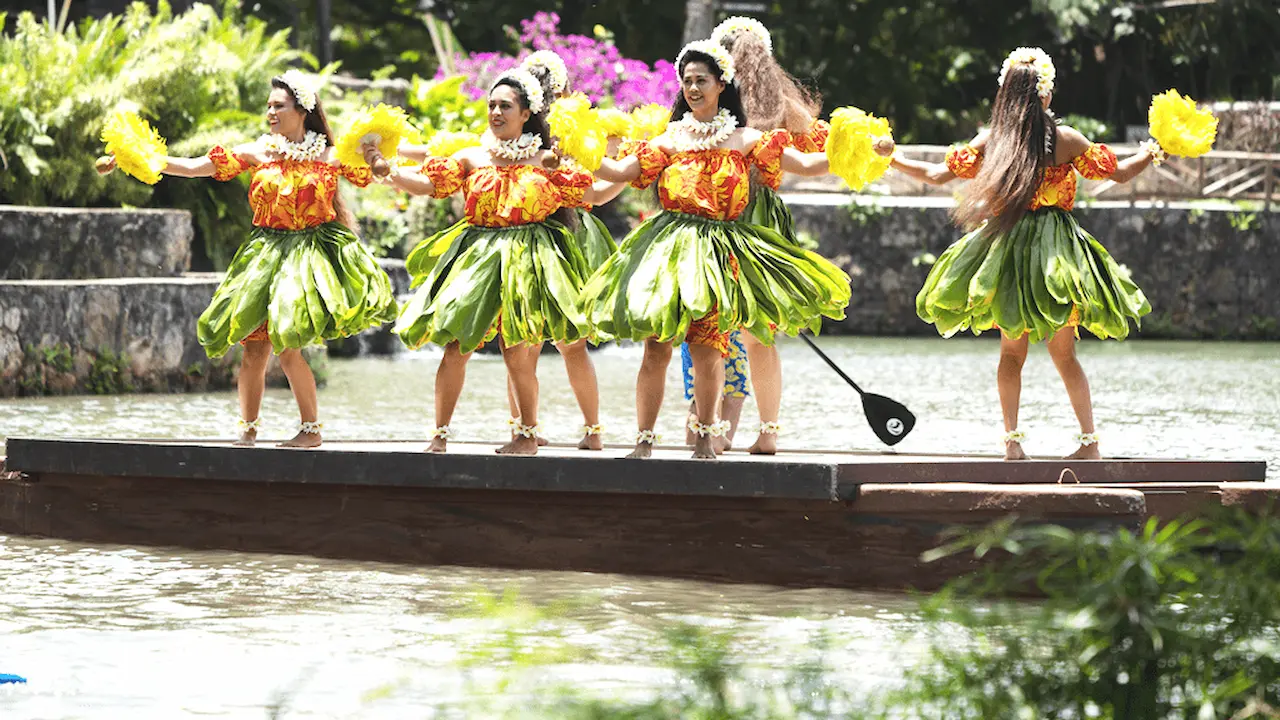
The final versions of three Huki costume designs created by Roger Ewens after consulting extensively with PCC cultural specialists and other members of the Huki committee: a 1940s-era Hawaiian hula outfit with ti-leaf skirt, a blue Fijian finalé outfit, and a historical Tongan king costume.
Creating a Brand New Canoe Show
Since the Polynesian Cultural Center staged the grand premiere of Huki: One ʻOhana Sharing Aloha on August 18, 2018, visitors may not realize that over four years went into planning and preparing the new canoe celebration. Costume design and production alone accounted for more than a year's worth of that time.
Note: ʻOhana means family
in Hawaiian. The PCC retired its former canoe pageant, Rainbows of Paradise, on July 11, 2018, after 18 years. Preparations for Huki’s premiere began the next day with a soft launch on July 12.
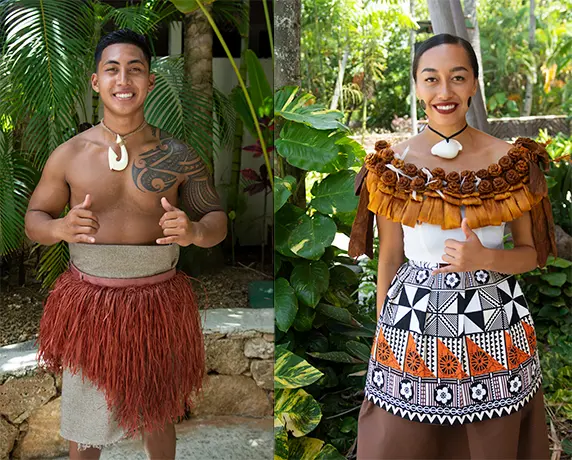
Finished Māori Huki costumes. Photo by Polynesian Cultural Center.
Meet the transplanted Aussie who oversees PCC costuming
We’ve used that time to tweak the costuming and tighten up many aspects of the production,
said Roger Ewens, a transplanted Aussie by way of New Zealand. As PCC Manager of Costume Design, he has worked closely with wardrobe supervisor Cathy Teriipaia, seamstress supervisor Fatai Feinga, and other Huki committee members to help design, produce, and maintain over 1,000 new costumes and accessories. He also oversees PCC’s uniform operations.
Ewens, originally from Mt. Gambier, South Australia, attended Church College of New Zealand, served a Latter-day Saint mission in Manila, Philippines, and then enrolled at Brigham Young University–Hawaii. After graduating in fine arts, theater, and travel management in 1986, he returned to Australia for further graduate studies in educational theater and Polynesian and Aboriginal studies. In 1991, PCC drafted him to help design costumes for the canoe show Legends of Polynesia, and he has been with the Center ever since.
As a boy in Australia, I never imagined I would be doing this,
Ewens said. He admits he got chicken skin
the first time he saw a Māori haka in New Zealand.
Working closely with PCC cultural specialists
Ewens explained that the design process involved close collaboration with cultural specialists. He keeps a book documenting his designs, suggested fabrics, and revisions. Cathy and Fatai’s teams of artisans and seamstresses immediately put the final designs into production.
We would talk about ideas, I’d do designs, and they would go back and forth until eventually, I’d do a final design. We mostly worked with sketches and swatches, coordinating with the seamstresses and wardrobe, who work with adornments like lauhala [pandanus leaves] and shells,
Ewens said.
Newer technology and outlooks
With few exceptions,
Ewens said, PCC people created all of the costumes and accessories. The seamstresses still play a key role, and our wardrobe department makes most of the accessories and costumes using natural materials. But a lot has changed in the process.
For example, Ewens recalled when he was a PCC student employee more than 30 years ago, the Theater Department used a makeshift set-up to silk screen custom designs onto bolts of material, which the seamstresses would then sew into costumes.
Designs are now created by infusing inks into polyester materials,
Ewens continued. They’re easier to make and maintain. We even use this method for many of our uniforms. We’re constantly experimenting so we can create authentic-looking yet durable costumes that can stand up to daily use and laundering.
Mixing modern and traditional materials
In some cases, our wardrobe people strip fabrics, trying to create an authentic ‘feel.’ Of course, we couldn’t use the real materials, because they would not hold up to the repeated performance schedule.
In other cases, rather than using real tapa [bark] cloth, we’ve used a thick pellon that we’ve dyed to the color we want. [Pellon is a non-woven fabric usually used to line and/or shape other material.] Then we’ve used bleach to create a pattern in the pellon. The finished results look very organic and authentic.
Creating an "organic" look
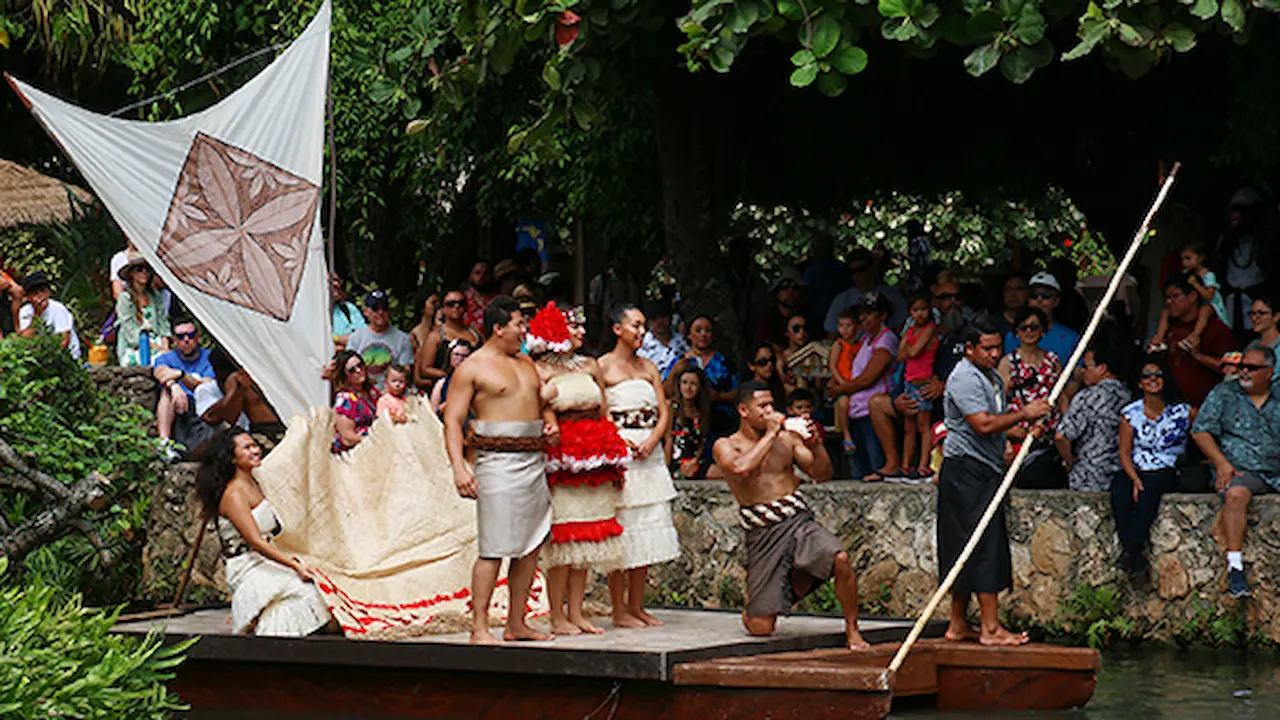
The cultural advisors told Ewens one of the early revisions they wanted was to make the costumes in the beginning part of Huki to look more ‘organic,’ because the people were still all one at that time and hadn’t divided yet into more distinguishable island groups. You’ll see that almost all of the costumes at this point are all in browns and beiges,
he said.
Costumes evolve over history and locations
While some of the costumes may look similar in the beginning, differences soon emerge. For example, only the Samoans use tuiga [ornate headdresses], and the Fijian men wear a lot of lauhala.
The costumes also change with the music.
For example, a female Māori trio sings a 1940s Big Band hit — in Māori. Samoans do their island adaptation of the country-western song Jambalaya. Everyone joins in Elvis Presley’s 1965 adaptation of the PCC’s signature song, Bula Lāʻie, into Drums of the Islands. And another group performs a Christian hymn dressed in typically white going-to-church outfits.
Consequently, our dancers are frequently dashing ‘off-stage’ and changing into something else. Of course, that’s why we have so many different costumes in Huki. We’ve never done anything like this before,
Ewens said.
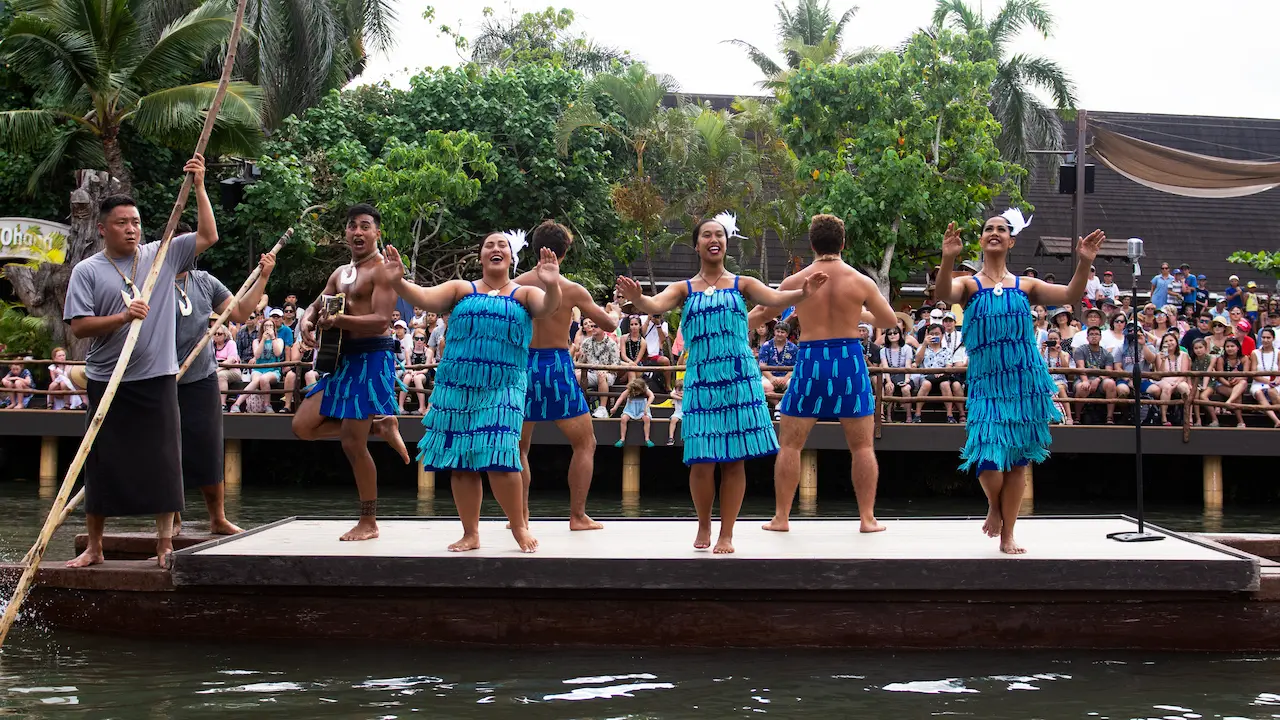
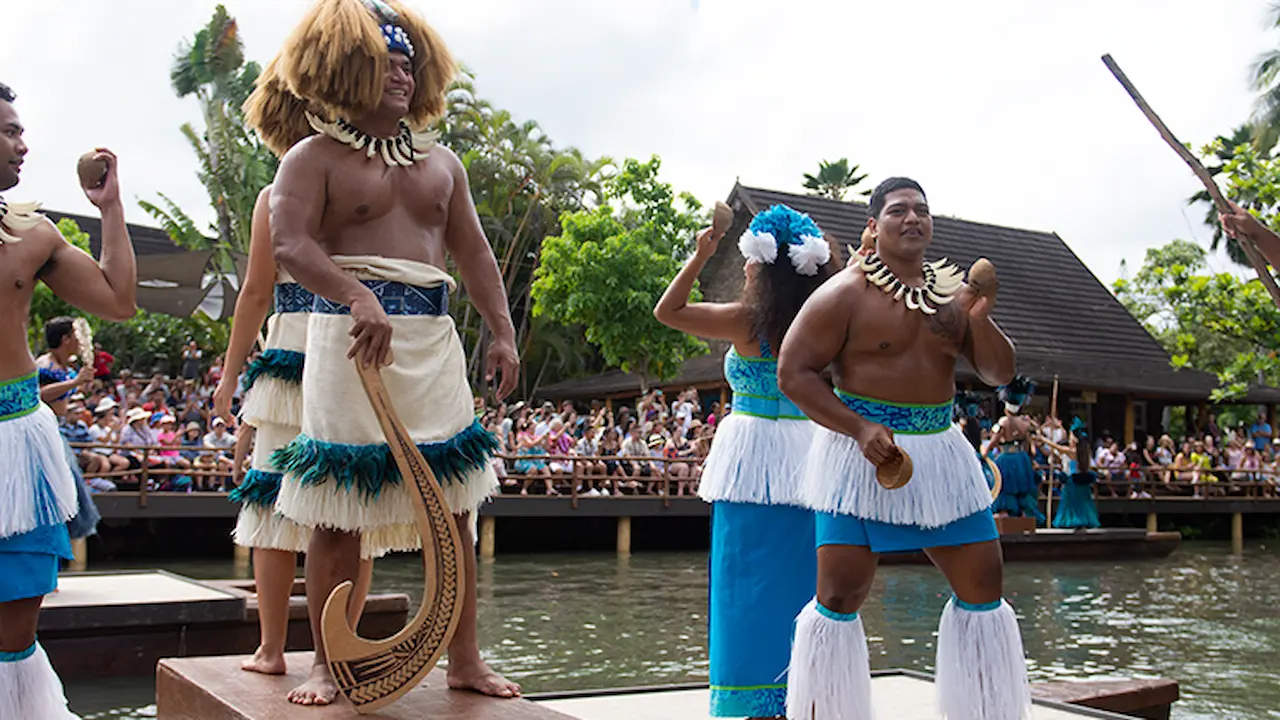
And by the finalé, everyone has changed again into blue-themed costumes, representing the ocean, which brings us together as one ʻohana.
Other logistical considerations
Ewens said PCC seamstresses produce Huki costumes in general sizes — small, medium, large, etc., and each performer generally uses three costumes per show. We also have backup costumes for each ‘role.’ Then, because villagers and guides also help out during Huki, they may also have some additional costuming requirements.
After a performance, we send a cart around to the three dressing areas to pick up all the costumes and take them to the laundry to get washed for the next day’s schedule. It’s highly coordinated.
He added he doesn’t know yet, but based on past experiences, he hopes each Huki costume will last about six-to-eight months before needing to be replaced.
The ones using organic materials will have to be replaced sooner. We’re constantly watching the wear-and-tear of the costumes, so they last as long as possible.
Huki’s blue finalé
Ewens said that creating blue-themed costumes for the finalé was a bit of a challenge. In every case, we worked with our own cultural experts to make sure the final costumes were culturally correct. Of course, I had some of my own ideas, but they liked what we were creating and felt that I was on track.
For example, Fijians traditionally didn’t use blue tapa [bark cloth], so how could we create something contemporary that looks traditional, and still be respectful to the culture?
He recalled they found a lady in Fiji who was willing to give it a try. She initially provided us with a tapa she printed using blue ink. We then sent her heavy pellon to print, and everyone here is pleased with those results. I’ve been told the other ladies in Fiji all loved it. Also, now when it rains the ink has already been fused into the pellon, so the color doesn’t run.
Huki focuses on the Polynesian Cultural Center story
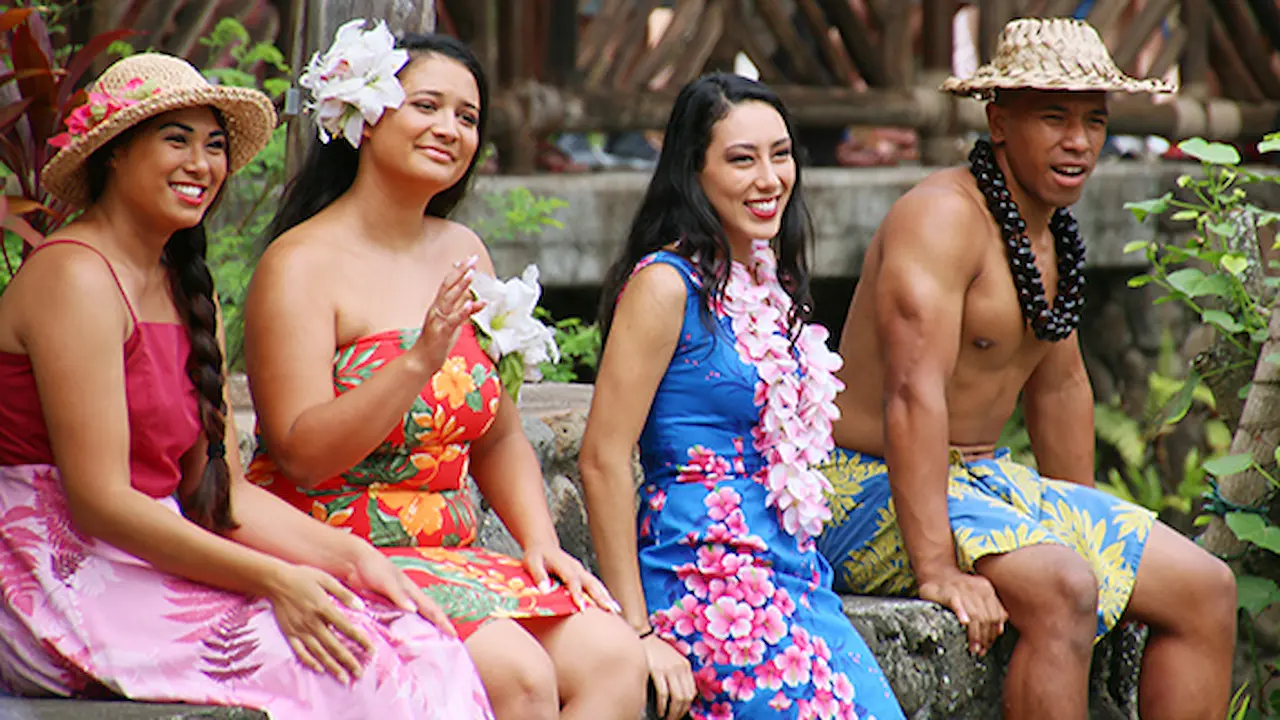
Over the three-year course of planning Huki, the storyline eventually evolved into a loose history of the Polynesian Cultural Center.
Early on we knew we didn’t want to focus just on dancing,
Ewens said. From a costuming perspective, I was very pleased we progressed from the beginning, where the people were all one. As new influences emerged, they became part of the culture. The people owned them. That’s what we’ve also tried to do with the costuming for Huki. I appreciate being able to pull all these things together in a different light that still says we’re a culture. We’re still alive, and we’re all one. We’re surrounded by the ocean, but we’re all pulling together, and we’re part of a family. We’ve come together again at the Polynesian Cultural Center.