








Lei Day in Hawaiʻi: The Polynesian Origins Behind May 1
Lei Day in Hawaiʻi: The Polynesian Origins Behind May 1
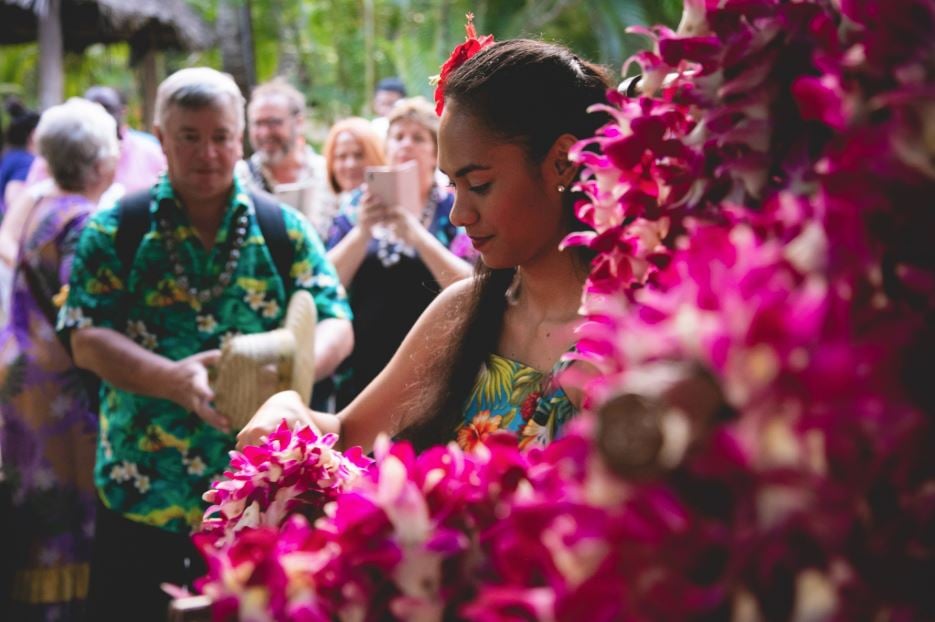
Lei Day in Hawaiʻi is celebrated every May 1, and it is far more than a floral holiday. For Polynesian people across the Pacific, the lei, in all its forms, has carried messages of love, honor, status, and remembrance for generations. At the Polynesian Cultural Center in Lāʻie, cultural ambassadors from six island cultures keep those traditions alive every day. This May, as Hawaiʻi marks Lei Day 2026, here is the story behind the lei; from its ancient Polynesian roots to the living traditions you can witness and experience today.
What Is Lei Day and When Did It Start?
Lei Day was first celebrated in Hawaiʻi in 1927, inspired by poet Don Blanding and promoted by songwriter Grace Tower Warren, who coined the phrase “May Day is Lei Day in Hawaiʻi.” The Hawaiʻi Legislature officially designated May 1 as Lei Day in 1929, making it a state holiday honoring the lei as a symbol of aloha and Hawaiian identity. Today, celebrations are held across the islands, with lei competitions, hula performances, and community gatherings marking the day. Honolulu's Kapiʻolani Park hosts the largest annual event.
In 2026, the Lei Day theme — Mai ka hoʻokuʻi i ka hālāwai (from zenith to horizon)— evokes the spirit of the voyaging tradition, a reminder that Polynesian culture has always moved across water. It is a theme that connects Lei Day directly to the deeper story of Polynesian navigation, identity, and kinship across the Pacific.
What Does a Hawaiian Lei Symbolize?
A Hawaiian lei is never just decoration. It is an expression of aloha: a word that carries the fullness of love, peace, compassion, and respect. Lei are given to honor guests, celebrate achievements, mark transitions from one stage of life to another, and welcome people home. To receive a lei is to be seen and valued. To place one on another person is an act of care that transcends language.
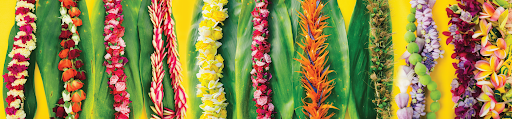
Lei can be made from flowers, leaves, seeds, shells, feathers, or greenstone, with each material carrying its own meaning. The Kamehameha Schools describe over a dozen distinct lei-making techniques, from simple wili (twisting) to complex haku (braiding), each one a form of living art passed down through family lines.
The Eight Hawaiian Island Flowers
Each of the eight main Hawaiian islands has an official flower and color, designated under Hawaiʻi Revised Statutes §5-16. These flowers and colors form the foundation of competitive lei-making each May 1:
Oʻahu — Ilima (yellow-orange), Maui — Lokelani rose (pink), Hawaiʻi Island — Pua lehua (red), Kauaʻi — Mokihana berry (green/purple), Molokaʻi — Pua kukui (white), Lānaʻi — Kaunaʻoa (yellow-orange), Niʻihau — Pūpū shell (white), Kahoʻolawe — Hinahina (silver-gray). Knowledge of these flowers deepens any appreciation of the island-specific lei traditions guests see during a visit to the island villages.
Lei Across the Polynesian Triangle: Six Cultures, One Spirit
What most Lei Day coverage misses is that the Hawaiian lei is part of a much larger Pan-Polynesian tradition. Across the Polynesian Triangle — from Hawaiʻi in the north, to Aotearoa in the southwest and Rapa Nui in the east — nearly every culture has its own garland tradition, each with distinct materials, techniques, and meanings. The table below maps the lei across the six cultures represented at the Polynesian Cultural Center:
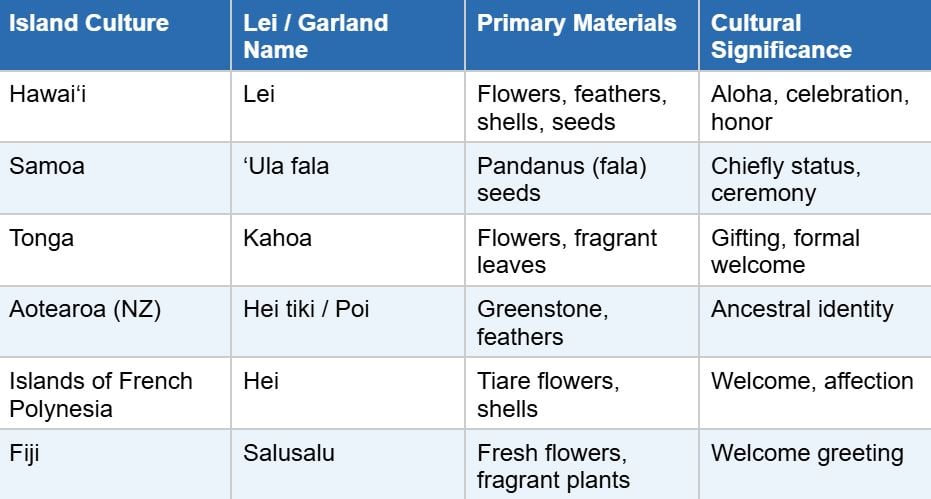
At PCC, guests can observe lei-making demonstrations within the island villages and learn the cultural context behind each tradition — something no travel blog or museum exhibit can fully replicate. The BYU–Hawaiʻi students and cultural ambassadors who staff each village are from these communities, and they are proud to share their lived knowledge.
Experiencing Lei Day Traditions at the Polynesian Cultural Center
The Polynesian Cultural Center in Lāʻie offers a uniquely complete Lei Day experience. Guests who visit on May 1, can experience many lei-making demonstrations. The Islands of Hawaiʻi village is especially relevant during Lei Day week, with activities that connect the lei to chant, hula, and the broader story of Hawaiian identity and sovereignty honored through the ʻOnipaʻa theme of the Aliʻi Lūʻau.
The Aliʻi Lūʻau itself opens with a Hawaiian greeting that includes traditional lei protocol — the presentation of lei as an act of welcome and honor. It is one of the most genuine expressions of aloha you will encounter anywhere on Oʻahu. The ʻOnipaʻa performance honors Queen Liliʻuokalani, whose life and legacy are inseparable from the flowers, chants, and cultural expressions that Lei Day celebrates.
Lei Etiquette: How to Give and Receive
If you're visiting Hawaiʻi around Lei Day, a few points of etiquette matter. A lei is always placed over the shoulders and around the neck — never handed to someone to put on themselves if you can help it. It is accompanied by a gentle embrace or kiss on the cheek among friends and family. You should not remove a lei in front of the person who gave it to you, as this can be read as a rejection of the aloha offered. When a lei has naturally wilted, it is traditionally returned to the earth — left at a tree, placed in the ocean, or allowed to compost — never thrown in a trash can.
Lei Day at the Polynesian Cultural Center
At the Polynesian Cultural Center, Lei Day is more than a celebration—it’s an opportunity to bring our community together. Each year, we host a Lei Making Competition for residents, highlighting the artistry, creativity, and cultural knowledge passed down through generations.
Participants carefully select materials, weave stories into their designs, and create lei that reflect both tradition and personal expression. The results are nothing short of stunning.
The winning lei and competition entries are proudly displayed in our Island of Hawaiʻi village, where guests and residents alike can enjoy their beauty up close. Each lei tells a story—of craftsmanship, cultural pride, and the enduring spirit of aloha.
Whether you’re wearing a lei, creating one, or simply admiring the artistry, Lei Day reminds us of the importance of honoring Hawaiʻi’s traditions and celebrating them together.
To learn more about Lei Day at the Polynesian Cultural Center and the resident lei-making competition, visit: https://www.polynesia.com/residents/lei-day
Frequently Asked Questions About Lei Day
What is Lei Day and when is it celebrated?
Lei Day is celebrated on May 1 every year in Hawaiʻi. It was established in 1929 as a state holiday honoring the lei as a symbol of aloha and Hawaiian identity. The holiday is marked with lei competitions, hula performances, and community events across the islands.
What does a Hawaiian lei symbolize?
A Hawaiian lei symbolizes aloha — love, respect, and connection. Lei are given to honor guests, celebrate milestones, mark transitions, and express care. They are made from flowers, seeds, shells, leaves, or feathers, and each material carries its own cultural meaning.
What are the eight Hawaiian island flowers?
Each Hawaiian island has an official flower: Oʻahu (ilima), Maui (lokelani rose), Hawaiʻi Island (pua lehua), Kauaʻi (mokihana), Molokaʻi (pua kukui), Lānaʻi (kaunaʻoa), Niʻihau (pūpū shell), and Kahoʻolawe (hinahina). These flowers form the core of competitive lei-making in Lei Day events each year.
What is the difference between a haku lei and a lei poʻo?
A haku lei is a braided lei made using the haku technique — weaving flowers and foliage over a ti leaf or other base. A lei poʻo (also called a haku lei poʻo) is a haku lei worn on the head, rather than around the neck. Both are considered among the most skilled and prestigious forms of lei-making.
Can you experience lei-making at the Polynesian Cultural Center?
Yes. Lei-making demonstrations and cultural activities related to the lei tradition are featured in the island of Hawaiʻi especially on May 1, Lei Day. The Aliʻi Lūʻau also incorporates traditional lei greeting protocols as part of its welcome experience.
Do other Polynesian cultures have their own version of the lei?
Yes. Every culture in the Polynesian Triangle has its own garland tradition: Sāmoa's ʻula fala, Tonga's kahoa, the Fijian salusalu, the Tahitian hei, and the Māori hei tiki. At PCC, guests can learn about each tradition through the six island villages, each one maintained by BYU–Hawaiʻi students from the culture it represents.
Is there a lei-making event for AAPI Heritage Month in May?
May is Asian American, Native Hawaiian, and Pacific Islander (AANHPI) Heritage Month, and Lei Day on May 1 is one of its most visible celebrations. The Polynesian Cultural Center, as a nonprofit institution dedicated to Polynesian cultural preservation, honors these traditions year-round. Visitors in May - especially on May 1 - will find the island villages and Aliʻi Lūʻau programming especially rich with cultural meaning.
Come Experience the Living Tradition
The lei is a thread that runs through every Polynesian culture — a tangible expression of aloha that connects people across thousands of miles of ocean. Lei Day is the perfect time to experience that connection in person. At the Polynesian Cultural Center in Lāʻie, the tradition is not performed for audiences — it is lived by those who carry it from their home islands to Oʻahu's North Shore. Plan your May visit through the packages page and come ready to learn, participate, and be welcomed with aloha.
For more on the cultural traditions you'll experience, read Why the Polynesian Cultural Center Is More Than Just a Lūʻau and the ʻOnipaʻa cultural history blog.